Wednesday, December 17, 2014

Give 'Me' A Break


“But I need something more! For if I know the law but still can’t keep it, and if the power of sin within me keeps sabotaging my best intentions, I obviously need help! I realize that I don’t have what it takes. I can will it, but I can’t do it. I decide to do good, but I don’t really do it; I decide not to do bad, but then I do it anyway. My decisions, such as they are, don’t result in actions. Something has gone wrong deep within me and gets the better of me every time.” Romans 7:17-20.

Have you ever had a day where you sat and thought to yourself, “What in the world is wrong with me?!” Out of frustration with our own repetitive madness we start to think, “Well, maybe I do need some help…” Paul hits the nail on the head when he describes how our sinful nature can frustrate our spiritual desires – things as simple as deciding to eat healthier and then finding yourself pigging out at Christmas parties or deciding to become financially disciplined then finding yourself “needing” the new Jordans. We are constantly bouncing between what our spirit needs and what our natural bodies cling to and it can feel like the system is set up for us to fail.
Self-discipline is a huge part of living a Christ-like life. Christ reminds us in Luke 9:23-24 that in order to be His follower we cant bring our selfish ways with us—trying to hang on to our old lives will only cause us to loose them.  Turning away from something you’re used to means a battle between what you want and what you know you need. Paul gets it. He wrote about the predictability of our “failures” and how helpless it can feel to try wholeheartedly and still mess up. It’s the one part of us we wish we could just lock away.
In all honesty there are parts of us that don’t find interest in pleasing God, parts that just want to satisfy themselves. That sinful nature can abruptly rear its ugly head in the least expected moments of our lives…and then it’s back to square one. Again.
As frustrating as that cycle can be, its important to remember that with all you’ve gone through and as far you think you have left to go in your walk with God, there are some who didn’t make it as far as you have. The spirit of frustration makes you beat up on yourself and criticize where you are in comparison to where we think we should be. It also clouds our view of how far we’ve come with God’s help. Paul’s letter goes on to explain how Christ set things up to help us when we want to serve God with all our hearts and minds, but get pulled by the influence of sin to do something completely different.
The exasperating and contradicting struggle of trying to control your sinful nature can even make you think being spiritual isn’t for you.  But leaning on God in weak moments and in situations we seemingly can’t handle allow Him to exercise His perfect strength in us. 


- Ayana

Wednesday, December 10, 2014

Check Yourself


By: Ayana Bryant-Weekes
 
One thing that bothers me is when someone asks for my opinion, then gets upset with what I’ve said. I instantly get irritated and frustrated with the person for creating a problem with something they involved me in. I’ve been an opinionated and outspoken person all my life and I learned the hard way that my opinion is a private possession and most effective when solicited or asked for.  I made sure I wasn’t pushy with my opinions and criticisms but I didn’t considered whether or not my criticism was constructive. I felt like what I had to say made more sense to me and was therefore correct and better for everyone.
Thinking back on certain situations where my frustration with someone not receiving my criticism led to an argument or huge fallout, I have a much better understanding of the saying, “It’s not what you say but how you say it.” I rarely considered the natural difficulty that comes with receiving criticism in the first place. Consequently, that put the other person on immediate defense.  
As we all know, criticism can be useful. Accepting suggestions from others is how we all learn to appreciate one another’s gifts and talents. However, we also need to know how to give constructive criticism. Whether we realize it or not, giving constructive criticism is a skill. Part of sharpening that skill is sincerity. This isn’t the normal “BS sandwich” that people learn about in corporate leadership courses and seminars.
                        BS Sandwich – sandwiching criticism between two positive statements. Lacks sincerity and can be detected a mile away.

Genuine constructive criticism isn’t about being right. It may seem weird but criticism is selfless. Constructive criticism doesn’t ask to be proven right or gain anything. It just wants to see someone be better at what they do.  Genuine criticism is not an attack on another person. Even if we offer critique to a friend directly about them, we should never judge or throw blame on them. No one stays interested in having a conversation where they are being attacked. That is why it helps to compliment the person on what you notice was good. Criticism that feels like an attack only focuses on “wrong”. Before we offer criticism, we should use it as a chance to encourage each other.

In Jeremiah 31:3 Christ reminds us that we were drawn to Him with loving kindness. It’s important that we keep that same attribute when dealing with our brothers and sisters in Christ.  Truth be told, being corrected can be a humbling experience and it can hurt. Knowing that, we have to remember when offering corrective criticism, you’re dealing with a person who can feel the same hurt when being corrected by you. It’s almost like a self-check system:

1.     Do I just want to be right?
2.     Am I attacking this person?
3.     What did they do well in the situation?

When you make sure you present a loving posture, anything you say, in love, can be easily received.


-Ayana

Wednesday, December 3, 2014

SHOTS FIRED


By: Ayana Bryant-Weekes
 
Shots Fired.

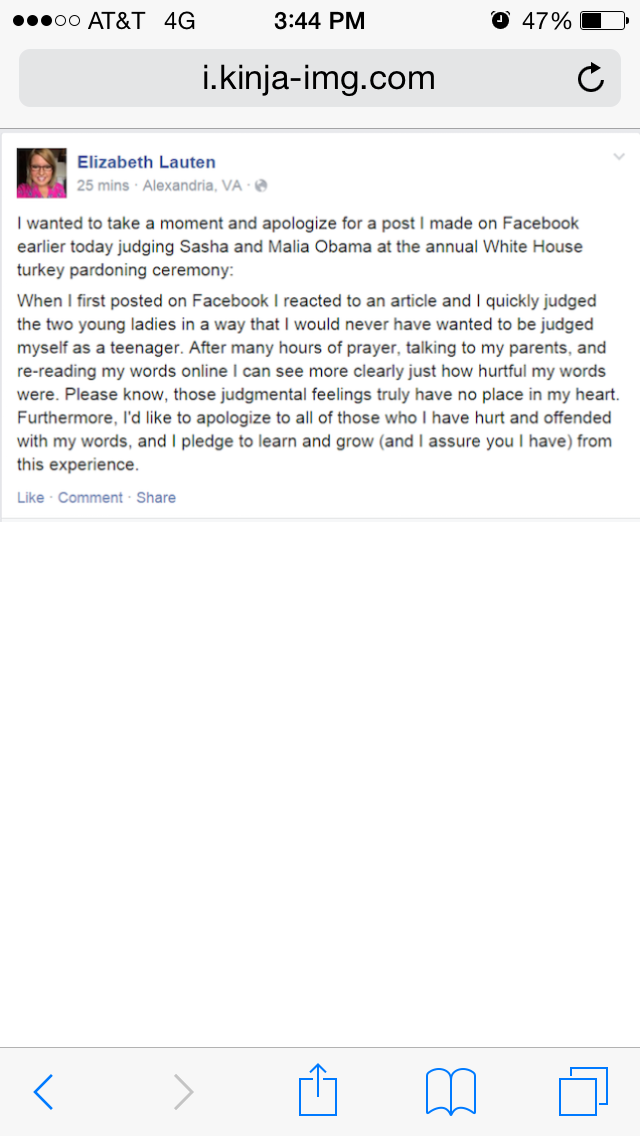
Black lives are being attacked on all sides, and while our young men are being shot and killed in the streets with no consequence, our young women are being openly condemned. Elizabeth Lauten, the communications director for Republican Rep. Stephen Fincher of Tennessee, fired shots via Facebook to express her disapproval of Sasha and Malia Obama’s behavior and clothing during last week’s Presidential Turkey Pardon. Sasha and Malia are two of the youngest presidential children in the White House (as noted by the Washington Post) and I could be alone in this opinion but I don’t see how Ms. Lauten figured that the pardon of a Thanksgiving turkey is in any way interesting or imperative enough to a 16 and 13 year old that it could peak their adolescent interests. Ms. Lauten also made it a point to use their attire as reason to disrespect them. 


The attack on the First Children by Ms. Lauten is lacking the very class she instructed them to have. She allegedly "prayed for hours" and then apologized for her classless rant but the thought that crosses my mind lately is that our children no longer enjoy childhood for being murdered and bullied at such young ages and not allowed to just be kids. Sasha and Malia are real teenagers; they yawn during Inaugurations, take Selfies, and wave off invitations to pet turkeys named "Cheese" but what teen wouldn’t? 

We need to protect black childhood. At all costs. Protect them from every teacher who dismisses black intelligence, anyone who ever unnecessarily sexualized a black child, and cops who see unarmed black children as attackers.

Wednesday, November 26, 2014

Keep Making Noise

What's up everybody, my name is Arthur Cartwright. I'm a writer/director and by the grace of God, I've worked as an actor with people such as Clint Eastwood, Christopher Walken, Val Kilmer, Laurence Fishburne and more. I also produce a traveling stage-play called "We Beat the Streets”, which is loosely based on the New York Times Bestseller of the same name. The play has been running for four years and has been seen by tens of thousands of people.
I fell in love with acting in the 5th grade and I'm now 25 years old, but I didn’t fall in love with simply acting, but telling a story and being a part of it. I really got into acting in high school, I started watching movies differently and really studied the craft. More importantly, I started studying the business. My father is a hardcore businessman, so not only did I have the artsy, poetic side of me that just wants to create, but I also wanted to do good business. I hear a lot of artists who just want to create and not worry about if a project does well financially or not, as long as it's out there. I commend them for that, but the business side of movie making always held my interest. I wanted to know how much movies made and what were the highest grossing projects of all time, whether it was film, television or stage.
 My mother used to play this game with me, asking me at any given moment throughout the day about who directed or produced or wrote a certain film, and I would answer it. She couldn't believe how much I knew about films and the people behind them. With this, I knew my senior year of high school I had to jump straight into the industry somehow. I got accepted into some universities but I decided to jump straight into acting. I sent out headshots and resumes to find an agent. It was perfect timing. At that time, the state of Michigan (where I was born and raised) gave out a tax incentive for films—the largest incentive offered by any state.
Michigan, for a good 2 years, was the filmmaking capital of the country. Hundreds of films were shooting in here from big ones to small ones and I was getting called to auditions for what seemed like every single one of them. The ones I was blessed to book ended up being big ones. My first gig was playing "Prez" in Gran Torino and I got to work with Eastwood and company and even attended the premiere at Warner Bros and went to California for the first time. After Gran Torino, I got other roles that put me on screen with people I looked up to in the film industry like Angelina Jolie, whom I met at Gran Torino’s premiere–I was on cloud nine.
Gran Torino became the highest grossing movie of Clint Eastwood's career so I decided to move out to California while the movie was hot. When I moved out there I got to see the business for what it was—extremely difficult and competitive. I saw that I was just one in millions that were trying to make it. This is when I started a production company and the business side of me came out. I produced “We Beat The Streets” and as a company, I was able to get into doors I may not have gotten into as an actor since I had been talking daily to the people who provided actors with jobs like network executives, producers, directors etc.


I became more interested in this side of the business because these are the people who create the stories that we see on screen. That's my focus and has been for a few years, I don't just want to be a part of the story anymore, I want to create the story I'm apart of. It's a tricky business because it's about who you know and everything seems like it's closed off to new comers. It takes an undeniable, relentless tenacity to make your mark. I pray ALOT, and I have Faith that God has my steps ordered. I do what I do and I let God do what He does. Now, I'm in a great place, I'm married to a beautiful, amazing woman that is a true friend and helper, business is good and most importantly growing, but still marching towards my goal which is to own a thriving movie studio. I have a ways to go, but I'm going to keep pushing, keep making noise.
Have you noticed you can't ignore a sound you don't recognize? If it's an unfamiliar sound, you have to find out where it's coming from right? You want to get noticed? Just keep making noise.


Arthur Cartwright
STH Productions
www.sthproductions.com
IG: @BlockbusterArt

Wednesday, November 19, 2014

Fast Cash


By: Ayana Bryant-Weekes

The other day I was indulging in my latest social media impulse, Snapchat, and I received a message from the Snapchat family. A video of two teenagers showing the ease of money wiring using “Snapcash” backed by a Broadway musical routine of singing, tap-dancers wearing dollar signs and holding giant debit cards glittered across my screen. Apparently, “with the swipe of three fingers you can make it rain,” on friends in your recent snaps.  Snapcash is virtually seamless, enabling users to quickly upload their debit cards and make payments to their peers by simply typing a dollar sign and payment amount in the chat box.


Long story short, this is yet another way for money to effortlessly fly out of my bank account. People at these mobile cash companies, Google Wallet, Square, and Apple Pay—just to name a few—have made the transfer of money that much more convenient. I learned about the concept of a mobile wallet in a marketing class I took in college. My professor foreshadowed the elimination of a physical wallet and at the time I shrugged it off thinking no one is going to actually use these mobile cash options as a replacement to physical money—that’s ridiculous. However, an article on MarketWatch.com explained that Snapchat’s 100 million tech-savvy 20-something active users who for the most part grew up with smartphones and the spirit of instant gratification, trust that the Internet will keep their personal and financial data “safe”.  Millennials (that’s us) are the most apt to incorporating these mobile processes into our daily lives since we’re already always glued to our phones.

            Don’t get me wrong, I understand (and appreciate) the ease of payments and money transfers with online bill pay, mobile bank transfers and the like but I’ve recognized that with the benefits of convenience follows a multitude of responsibility. Again, it’s becoming way too easy for money to get away from us, and consequently much more tempting to frivolously spend. $20 here, $15 there and we don’t even realize it until we’re left with $1.23 in our bank accounts because the money spent so easily (don’t front like it hasn’t happened to you).

            “Snapcash” is really cool, uniquely innovative and very relevant to the times we live in but the challenge now is that self-discipline and self-control become even more important to our money management practices. I mean, who isn’t tempted just a little bit to try it? I just want to see if actual Snapdollars will drizzle down my screen if someone sends me money.


- Ayana

Wednesday, November 12, 2014

Message In a Bottle


 By: Ayana Bryant-Weekes

Most people today claim to be introverts, people who are more comfortable being by themselves, relying on themselves and entertaining others only for a short while. The thing about introverts is that most of the time (if not all the time for a true introvert) when an outlet is needed, the introvert only finds comfort within themselves. For these people and others who aren't necessarily true introverts but share the same conundrum of needing someone to share with but not feeling comfortable sharing with anyone, a lot of things are left unsaid. I call this the Message In A Bottle Syndrome.

This is when beautiful things, poetry, novels, ideas, revelations, inspirations, art, comedy etc. are bottled up inside of people waiting for someone to find it and unleash it. The beauty in stumbling upon a bottle washed up onto shore with something inside of it is the element of seemingly finding a treasure. The beauty is also found in the fragility of the vessel and how it survived the graceful monstrosity that is the ocean.

Most of us keep things inside of us out of fear that if we unleash a piece of our soul, it won't be appreciated or respected as much as if someone finds it, so we keep everything bottled up. Whoever places a piece of their soul into a bottle and sets it out to sea knows that some may find a bottle washed up onto shore and ignore it, and some will find a gift, a treasure to be enjoyed and savored. the difference is in who took the time to open it.

-Ayana


Wednesday, November 5, 2014

Forget Not His Benefits


Imagine the physical effects of smoking a pack of cigarettes everyday for 40 years—pretty horrifying, right? Well, imagine that the absence of prayer, meditation, church fellowship, and the space for God to move on your behalf have that very same physical effect. The old saying goes “An apple a day keeps the doctor away” but can a prayer a day do the same? An article in Relevant Magazine (maybe you can tell by now that Relevant is my favorite faith based magazine) written by Rob Moll, award winning journalist and author of What Your Body Knows About God, breaks down these “5 Ways Your Faith Improves Your Health”.

1. Faith Encourages Healthy Behavior
2. Faith Reduces Stress
3. Community Improves Emotional Health
4. Helping Others Improves Life Satisfaction
5. Space for the Miraculous

The measurable health benefits of Faith, blood pressure, strength of the immune system, and the offset of the effects of mental illness are also mentioned but what I loved most about the article was the 5th health benefit— Space for the Miraculous. Some will say that the health benefits of Faith are all in a person’s head, and I have to agree. The article references The Placebo Affect, which is a person’s response to a treatment that seems to be real but isn’t.  Now, my belief in this theory isn’t the same as a skeptic’s but it is based on the mantra of my Pastor, Bishop J. Drew Sheard, “If you can’t see it before you see it you never will see it.” That motto has always activated my imagination to believe for something that wasn’t necessarily true yet, and that’s all faith is, the substance of things hoped for and the evidence of things not seen (Hebrews 11:1).  So maybe it is the Placebo Effect but the bottom line is, Faith can help improve a person’s health.

 “…If we believe that God's authority stretches to the physical as well as the spiritual, then we can accept that He can manifest that authority in our physical health as well as our spiritual health.”

Take a look at The Surprising Links Between Faith and Health here.


-Ayana